A One-Page Marketing Plan for Your Small Business in 2027
SplashSol • Practical 2027 planning
Published 24 November 2026 · Examples are labelled · Sources below
Quick answer
A useful one-page marketing plan names the customer, offer, next action, channels, budget and weekly owner. Set one measurable business goal, choose a few activities you can maintain and review suitable enquiries and sales each month.
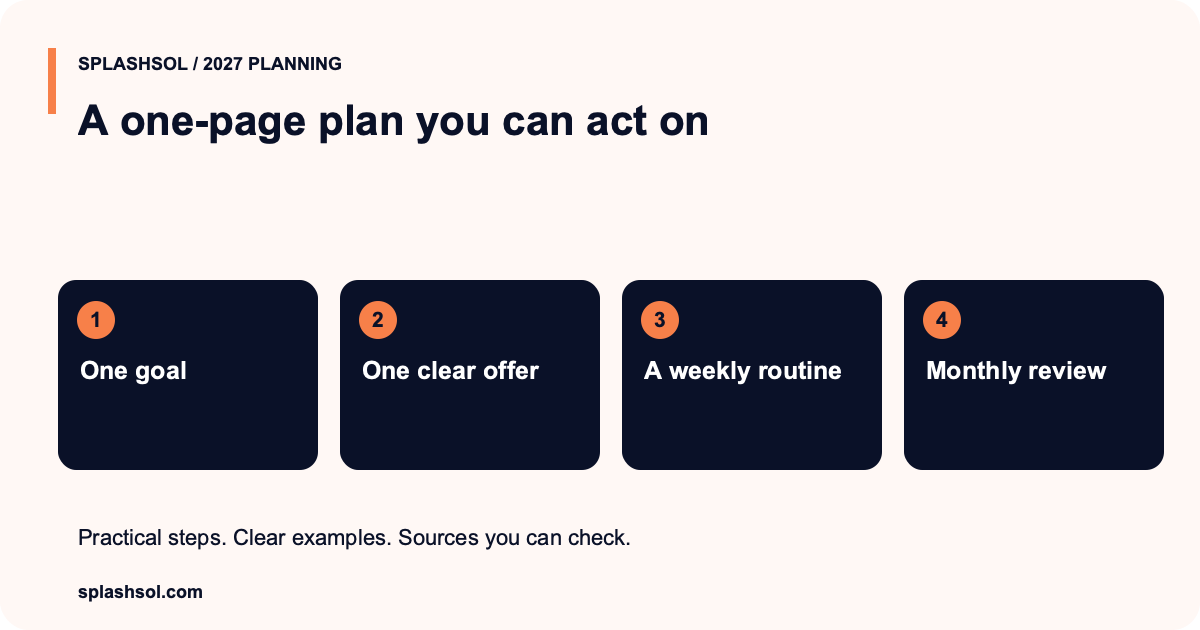
One clear goal, an offer customers understand, a weekly routine and a monthly review.On this page
Give the page one clear purpose
A marketing plan should help you decide what to do on Monday morning. If it becomes a long list of channels and ambitions, it is harder to use. This template keeps the decisions on one page and puts the supporting dates and spending in separate worksheets.
Use a 90-day working period inside your 2027 plan. A full year gives direction, but the next three months are easier to resource and review. Keep the assumptions visible so you can change course when the evidence changes.
The one-page template
Copy these fields into the Marketing plan workbook tab
Decision
What to write
Check
Business goal
The type and amount of work you want, by a date
Can you fulfil it with your current capacity?
Customer
A specific buying situation and area you can serve
Is this based on real enquiries rather than a stereotype?
Offer
What you do, what is included and the next step
Can a customer understand it without jargon?
Main page
One service or product page for the campaign
Does it answer the buying questions and work on a phone?
Channels
Two or three realistic ways people will find it
Who will maintain each one?
Weekly work
A short repeatable action list with an owner
Does the time exist in the diary?
Budget
Cash spending and owner time, kept separately
Are setup costs and recurring fees visible?
Measurement
Suitable enquiries, sales and contribution where known
Can you explain where the figures came from?
Completed example: a local plumber
Fictional planning example. This is not a SplashSol client result. “Glenview Plumbing” is a made-up name used to demonstrate the template.
Goal: book six additional non-urgent plumbing jobs a month during January–March, subject to diary capacity.
Customer: homeowners in the real service area who need the specific repairs the business offers.
Offer: an enquiry with the fault, location and photos, followed by a clear explanation of the next step. No invented fixed price.
Main page: plumbing repairs, with service area, actual hours, call route and a short enquiry form.
Channels: accurate Google Business Profile, useful local service content and a review request after completed work.
Weekly work: check enquiries, add one genuine job example with permission, respond to reviews and test the form.
Budget: use a stated owner-time allowance and a separately approved cash limit. Start with the available budget rather than an assumed industry percentage.
Measure: suitable enquiries, jobs booked, work completed and contribution after variable costs. Record the starting point before making changes.
Two other businesses would make different choices
Fictional examples: choose the goal that fits actual capacity
Business example
90-day goal
Useful activity
Avoid
Independent salon
Fill a defined number of available appointment slots
Show service duration, preparation, prices and genuine availability on the booking page
Promoting appointments the diary cannot accept.
Small accountancy practice
Receive enquiries for one service it can take on
Publish a clear service explanation, required information and consultation route
A generic “we do everything” message or unqualified tax claims.
Turn the plan into a weekly routine
Monday: check new enquiries and decide what needs a reply. Record the source when it is known.
Once a week: improve one buying question, form field or useful example on the main page.
After completed work: ask for an honest review through the appropriate process. Do not offer rewards for positive reviews.
Month-end: compare spending and time with suitable enquiries, bookings and completed work. Keep notes on cancellations and unsuitable enquiries too.
How to choose channels
Choose channels that match the buying situation. A person needing a nearby service may search Google; a returning customer may respond to a useful reminder they have agreed to receive; a visual business may benefit from showing real work. You do not need to launch every channel at once. If the website cannot explain the offer or the business cannot answer enquiries, fix that before adding more traffic.
More impressions can mean a wider range of searches, not necessarily more ready-to-buy customers. Fewer enquiries may still produce better work if they are more suitable. Keep the business outcome beside the website measure. If nothing improves, check the offer, page, audience and response process before simply posting more.
Use the last three months as your starting evidence
Before choosing next year’s activities, spend an hour looking at recent enquiries and completed work. Note what people asked for, how they found the business when known, why suitable enquiries did or did not become customers, and which jobs the team would like more of. A small set of real conversations can reveal more than a long list of marketing ideas.
Keep facts and assumptions separate. “Four customers mentioned Google” is a recorded observation. “Most customers must come from Google” is a conclusion that may need more evidence. Some people will see several things before contacting you, and some will not remember. Record “unknown” rather than assigning every enquiry to the channel you happen to be promoting.
Look at capacity as well as demand. If the business can accept only a few additional jobs, a sensible plan may focus on the right jobs and clearer qualification. If the diary is quiet because quotes are slow to leave the office, improving that process may take priority over publishing another article.
Describe a buying situation rather than an imaginary customer
A useful customer description explains the problem, location and decision the business can help with. For a joiner, that might be a homeowner seeking built-in storage who needs to understand the design and measurement process. For a cleaning business, it might be a local office manager comparing a regular service with a clear specification.
Write down what the person needs to know before making contact. Can you work in their area? Is the service appropriate for their property or premises? What information should they send? What happens after the enquiry? These questions lead to useful page content without inventing personal characteristics or assuming that everybody buys in the same way.
Use the language found in genuine enquiries. If customers ask about “fitted wardrobes”, a page full of internal workshop terminology may miss the point. Explain necessary technical terms where they help the decision, but keep the main offer understandable to someone who has never bought the service before.
Write an offer with a clear next step
An offer can be straightforward: a particular service, the area covered, what is included and the way to start. It does not need a discount. A local business can make the decision easier by explaining the quotation process, likely preparation and who the customer will speak to.
Consider a fictional cleaning company replacing “quality cleaning solutions” with “regular office cleaning in our stated service area, with an agreed task list and an initial site visit”. The second version tells a potential customer what the business does and what happens next. Any claim about availability, checks or service standards still needs to reflect the actual operation.
Choose one main action for the campaign page. It could be requesting a quotation, checking an appointment or sending project details. Keep alternatives for people who need them, such as an accessible contact route, but avoid giving every button the same visual priority. The action should match the stage at which the customer is ready to decide.
Choose a small set of measures before the campaign starts
Set a baseline for the main outcome and write down how it will be counted. This prevents a month-end report from changing its definition to make the numbers look better. The following table shows sensible distinctions; it does not prescribe targets or claim industry averages.
Keep each stage of the customer journey separate
Measure
Working definition
Question it helps answer
Suitable enquiry
A real request for a service and area the business can provide.
Are the activities attracting the right work?
Quoted enquiry
An enquiry assessed and given an actual proposal or price.
Are useful requests progressing?
Confirmed booking
A place accepted under the business’s real booking process.
Are customers committing?
Completed work
The agreed job or service has been delivered.
Is the plan creating work the team can fulfil?
Contribution estimate
Sales value less the stated variable delivery costs.
Could the work cover the campaign cost under these assumptions?
A business does not need an elaborate reporting system for this. A simple shared record can be enough if it is maintained consistently and access is appropriate. Avoid collecting unnecessary customer information just to make a marketing spreadsheet look complete.
Use a 90-day plan with a weekly owner
Break the first quarter into preparation, publication and review. In the first month, repair the main service page, confirm the enquiry route and gather the evidence needed for the offer. In the second, run the chosen activities consistently. In the third, review the outcomes and decide which work deserves more time.
Assign actual diary time. “Post more often” is difficult to act on. “The owner spends forty minutes on Thursday preparing one genuine project example, and the office checks replies every working morning” describes work that can be managed. Change the timing to fit the business rather than copying this example as a fixed routine.
Give each action a backup owner where possible. If the usual person is away, somebody needs to know where the approved photographs, offer details and customer messages are kept. This matters especially around Christmas closures and January reopening. The 2027 calendar can hold those preparation and review dates.
Worked example: testing one service for a small salon
Imagine a fictional salon with six bookable gaps in its diary for a particular service over the coming month. Its goal is to fill those genuine spaces with suitable appointments. Before promoting them, the owner checks the service description, price, duration, preparation instructions and booking availability. These are invented planning circumstances, not a client result.
The salon chooses a current service page, an accurate profile update and a small set of original social photographs. It avoids advertising immediate availability after the spaces have been filled. A staff member checks that each enquiry receives the information needed to book and records whether the proposed appointment suits the customer.
At review, the owner compares suitable enquiries, appointments accepted, cancellations and completed visits. If enquiries arrived but did not book, the next question is why: timing, price, service suitability or a slow reply may each need a different response. The plan should record that reason instead of assuming another social post will solve it.
Connect the page, the budget and the response process
The marketing plan should point to one current version of the offer. Link the relevant service page from supporting content and check that its details match booking messages and staff replies. If a price or availability changes, update the destination page first and then review the other places where the offer appears.
Use the budget template to record cash commitments, setup fees and experiments. Keep owner time visible too. An activity with no advertising bill still uses hours that could have been spent serving customers or preparing quotations.
Agree what happens after somebody responds. Who receives the form? How quickly can the team realistically reply? Which details are needed next? Use the enquiry reply templates as a starting point, then adapt the wording to the actual service. The page and the reply should feel like parts of the same business.
Decide in advance when to change the plan
Write a short review rule beside the goal. For example: investigate the targeting if most enquiries are outside the service area; inspect the page and reply process if suitable enquiries do not progress; pause promotion when available capacity is filled. These are practical decisions, not automatic rules that guarantee a result.
Make one meaningful change at a time when possible and note the date. That makes the next review easier to interpret. Keep what the evidence supports, remove activities the team cannot maintain, and carry the useful lessons into the next quarter. A one-page plan earns its place when it changes the work people actually do.
Frequently asked questions
What belongs in a one-page marketing plan?
A goal, customer, offer, main page, channels, weekly actions, owner, budget and a measurement plan. Supporting research and calendars can sit elsewhere.
Do I need paid advertising?
No. Choose it only when the offer, tracking, budget and capacity make sense. Owner time and existing customer relationships also have costs and limits.
Can I edit the examples?
Yes. The workbook is free to download and edit. Replace the fictional examples and assumptions with your own figures and information.
Sources and checks
Prepared for 2027 planning. Sources checked on 24 November 2026; provider prices and product screens can change.