Published 24 November 2026 · Examples are labelled · Sources below
Quick answer
Set a marketing budget you can fund, separate setup costs from monthly spending and compare the cost with suitable enquiries and contribution from completed sales. The free workbook includes editable monthly inputs, annual totals and a labelled break-even example.
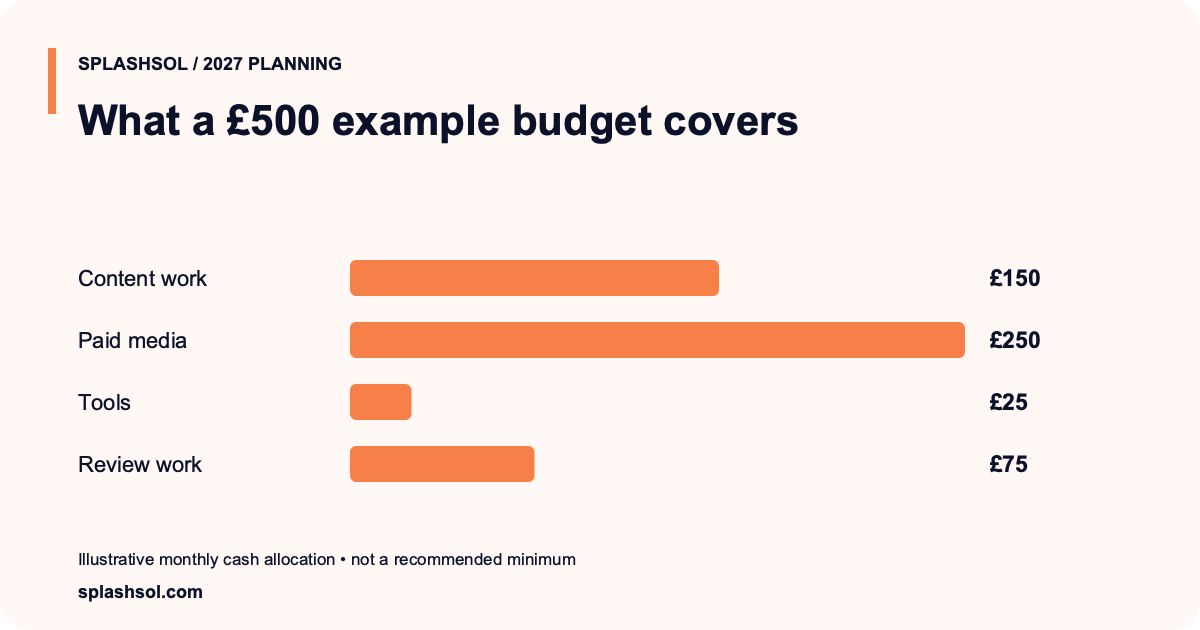
A fictional £500 monthly cash allocation. Owner time, setup and applicable tax are excluded.On this page
Start with available cash and a business goal
A percentage of turnover can be a planning reference, but it cannot tell a particular business what it can afford. A new salon with empty appointment slots, a fully booked joiner and an established consultancy will make different choices. Begin with the work you want, the capacity to deliver it and the cash available after other commitments.
The workbook is a planning aid, not an accounting system or a promise of marketing returns. Example values are invented. Replace them with quotes, cash limits and your own records; confirm the applicable tax treatment with the people responsible for your accounts.
What the editable budget contains
No macros, email gate or external data connection
Part
Use it for
How it works
Monthly channel inputs
Planned cash spending from January to December
Edit the blue figures; totals use formulas.
Setup row
One-off costs such as an agreed initial build
Keep it separate so the ongoing monthly run rate is clear.
Annual totals
Compare channels and total commitment
The workbook adds the twelve months.
Contribution example
Estimate sales needed to cover the plan
Enter sale value, variable delivery cost and an assumed conversion rate.
Notes
Scope, tax basis, quote dates and owner time
Record assumptions instead of hiding them in a total.
A £500 monthly example
This fictional allocation demonstrates the worksheet. It is not a recommended minimum, a provider quote or a forecast. “Website and content work” represents an allowance the example business has chosen; it does not imply that a particular service is available for that amount.
Illustrative steady monthly allocation
Budget line
Monthly cash assumption
Annual at the same rate
Website and content work
£150
£1,800
Paid media
£250
£3,000
Tools
£25
£300
Measurement and reporting work
£75
£900
Total before any setup or applicable tax
£500
£6,000
Owner time is not included in this cash total. Record the hours separately and check that somebody can do the work. A low cash budget can still require considerable time. If you add a one-off £600 setup in January, this example’s annual planned cash spend becomes £6,600, with £1,100 in January and £500 in the other months.
Use contribution, not just sales value
Suppose a fictional job sells for £300 and has £180 of variable delivery costs. The contribution before fixed overheads is £120. A £500 marketing plan would need at least five additional completed jobs to cover that spend in this simplified example: £500 ÷ £120 = 4.17, rounded up.
If the business assumes that 40% of suitable enquiries become completed jobs, five jobs would require at least thirteen suitable enquiries in the rounded planning model. This is an assumption to test, not a conversion benchmark. Fixed overheads, refunds, capacity, cash timing and applicable tax are outside that simple calculation. Covering the marketing spend is not the same as making an overall profit.
How to set the first three months
Write one outcome in the one-page marketing plan, such as additional suitable bookings for a defined service.
Check the service page and enquiry process before paying to send more people there.
List committed recurring fees, then decide what is available for experiments.
Enter one-off costs in the setup row and a monthly amount for each channel. Use zero only when you intend no spend; put missing quote details in the notes.
Set a review date and a stop or change rule. For example, investigate unsuitable enquiries before increasing the spend.
Compare budget with reality
At month-end, copy the workbook for the next review or keep a dated version. Record actual invoices and actual outcomes in your normal accounts and enquiry records, then compare them with the plan. Do not label a planned figure “actual”. Keep enquiry source information consistent; “Google” may mean paid advertising, a map listing, organic results or a customer searching your name.
The UTM builder can help label campaign links consistently. It does not solve every attribution problem, and personally identifying information should not be placed in tracking parameters. The 2027 marketing calendar helps place spending before the dates when customers need to decide.
Questions to ask before increasing the budget
Are the enquiries suitable and can the business fulfil them?
Are response delays or missing information losing otherwise suitable enquiries?
Does the claimed return use contribution, with the assumptions shown?
Has a change in season, pricing or capacity affected the comparison?
Would a smaller website or response-process improvement be more useful than more advertising?
Build a budget from commitments before experiments
List the costs the business has already agreed to pay. These might include website care, software, a content arrangement or an annual renewal. Record the amount, payment date, cancellation terms and the person responsible. Then decide what cash remains available for a new campaign. This prevents an apparently affordable experiment from sitting on top of forgotten commitments.
Separate the cost of running the business’s marketing from the cost of buying attention. Advertising spend is one line. Preparing a useful page, taking photographs, answering enquiries and reviewing results are different jobs. A campaign can spend little on advertising and still require substantial work from the owner.
Keep the first version understandable. If a cost is unknown, write “quote needed” in the notes rather than treating it as free. Use an assumption only when it is clearly labelled and somebody has a task to replace it with a current price. A neat total built from missing figures is not a dependable budget.
Put payment dates beside the annual total
The example earlier in this guide includes £500 each month and an additional £600 setup payment in January. That makes the first quarter’s planned cash spend £2,100. The average across three months is £700, but the January payment is still £1,100. Averages are useful for comparison; payment dates are what the bank account has to accommodate.
Fictional first-quarter cash schedule using the guide’s example
Month
Ongoing plan
Setup
Cash total
January
£500
£600
£1,100
February
£500
£0
£500
March
£500
£0
£500
First-quarter total
£1,500
£600
£2,100
Check annual software renewals, photography deposits and payment milestones the same way. If several renewals fall in a quiet trading month, discuss the timing with suppliers before making a new commitment. Do not assume a monthly advertised price means the supplier will collect only one month’s fee at a time.
Show planned, committed and actual spending separately
A plan is the amount you intend to spend. A commitment is an amount already agreed with a supplier. Actual spending is what has been charged or paid according to the basis you use for the review. Keep those definitions consistent. Otherwise a campaign may appear under budget simply because an invoice has not arrived.
At review, note the reason for any difference. A delayed website project, a paused advert and a lower software bill need different explanations. Carry a delayed commitment into the relevant future month rather than quietly removing it. If a campaign is cancelled, check whether any minimum term or outstanding work still has to be paid.
Keep tax treatment clear and consistent when comparing quotes. This worksheet does not decide the business’s accounting or tax position. Use the basis agreed with the person responsible for your accounts and record whether a supplier’s figure includes or excludes applicable tax. Compare the actual commitment, not two prices presented on different bases.
Measure enquiry quality before calculating a cheap lead
A low cost per form submission can be misleading if most requests are irrelevant. Define a suitable enquiry before starting. The definition might require the requested service, the real coverage area and a viable next step. Record spam and unsuitable enquiries separately rather than counting them as potential customers.
Suppose a fictional campaign spends £500, receives twenty messages and identifies ten suitable enquiries. The cost per message is £25; the cost per suitable enquiry is £50. Those are two different measures. If four of the ten become completed jobs, the marketing cost per completed job is £125 in this simplified example.
Now compare that cost with the contribution from the work. Using the earlier fictional £120 contribution per job, four jobs contribute £480 before fixed overheads, leaving £20 of the £500 marketing spend uncovered. This does not establish the campaign’s long-term value or the business’s overall profit. It shows why counting messages alone can hide an expensive result.
Use a range when the conversion assumption is uncertain
A new campaign rarely has a dependable conversion rate before it starts. Instead of presenting one optimistic figure as a forecast, test a few clearly labelled assumptions. Keep the contribution figure and spending fixed so you can see how the enquiry-to-job assumption changes the required volume.
In the £500 spend and £120 contribution example, the simplified model requires five completed jobs. At an assumed 25% conversion rate, five jobs require twenty suitable enquiries. At 40%, rounding up gives thirteen. At 50%, the model requires ten. These percentages are invented scenarios, not industry benchmarks or promised performance.
Replace the assumptions with actual records as evidence develops. Keep cancellations, repeat business and delivery capacity visible. Do not add the full value of possible future repeat purchases to make a weak first campaign appear profitable unless the estimate has a clear basis and is kept separate from completed revenue.
Allow for the time needed to answer the response
A campaign can create a workload problem before it creates additional profit. Ask how many suitable enquiries the team can review, how long an assessment takes, and who prepares estimates. If the only person who can quote is already fully occupied, more forms may simply lengthen the waiting time.
Record owner time alongside cash spending, even if it is not included in the workbook’s cash total. A weekly hour spent checking pages and replies is a real allocation of capacity. So is an afternoon taking photographs or preparing a proposal. Keep the estimate modest and review whether the work actually happened.
Before increasing spend, check the response process and the service page. A clearer form or a better explanation of coverage can reduce unsuitable requests. That may improve the use of the existing budget before the business needs to spend more.
Give each experiment a question and a stop rule
A useful experiment tests a specific decision. For example: does a clearer project-enquiry page produce more requests containing the information needed for an estimate? Or does a narrowly targeted advert reach people in the area the business actually serves? “Get more traffic” is too broad to explain what should happen next.
Agree the funded amount, review date, owner and evidence to collect. Define what would make the business pause or change the experiment: a broken form, a high proportion of unsuitable enquiries, no remaining appointment capacity or spending beyond the agreed limit. The rule should protect a real business constraint rather than force a verdict from a tiny sample.
Write the decision into the one-page marketing plan. Put preparation and review dates in the 2027 calendar. That keeps the money, the work and the business goal connected.
Ask better questions when a supplier proposes a bigger budget
Request the reason for the increase in terms you can check. Which work will be added? What is already working? Is the extra amount for media, management, content or development? A larger package may be appropriate, but it should have a clearer explanation than “more budget means more growth”.
Ask for the total commitment and the assumptions behind any projected result. Keep a record of what depends on your team, such as approving content or answering enquiries. Decide whether to increase spending only after checking cash, capacity and the evidence from the current plan. A budget should help the business choose, not pressure it into treating every available channel as essential.
Frequently asked questions
How much should a small business spend on marketing?
There is no single amount that fits every business. Set a funded limit using your goals, capacity, cash position and expected contribution, then test the assumptions against real results.
Does the template include formulas?
Yes. Monthly inputs feed annual and channel totals, and a simple contribution example calculates rounded jobs and enquiries needed to cover the selected monthly spend.
Are the examples inclusive of VAT?
No VAT assumption is applied. State your own consistent basis and confirm the amount you will actually pay before making decisions.
Can I use it without paid advertising?
Yes. Set the paid-media input to zero and allocate the funded budget to the work you have chosen. Keep owner time visible separately.
Sources and checks
Prepared for 2027 planning. Sources checked on 24 November 2026; provider prices and product screens can change.