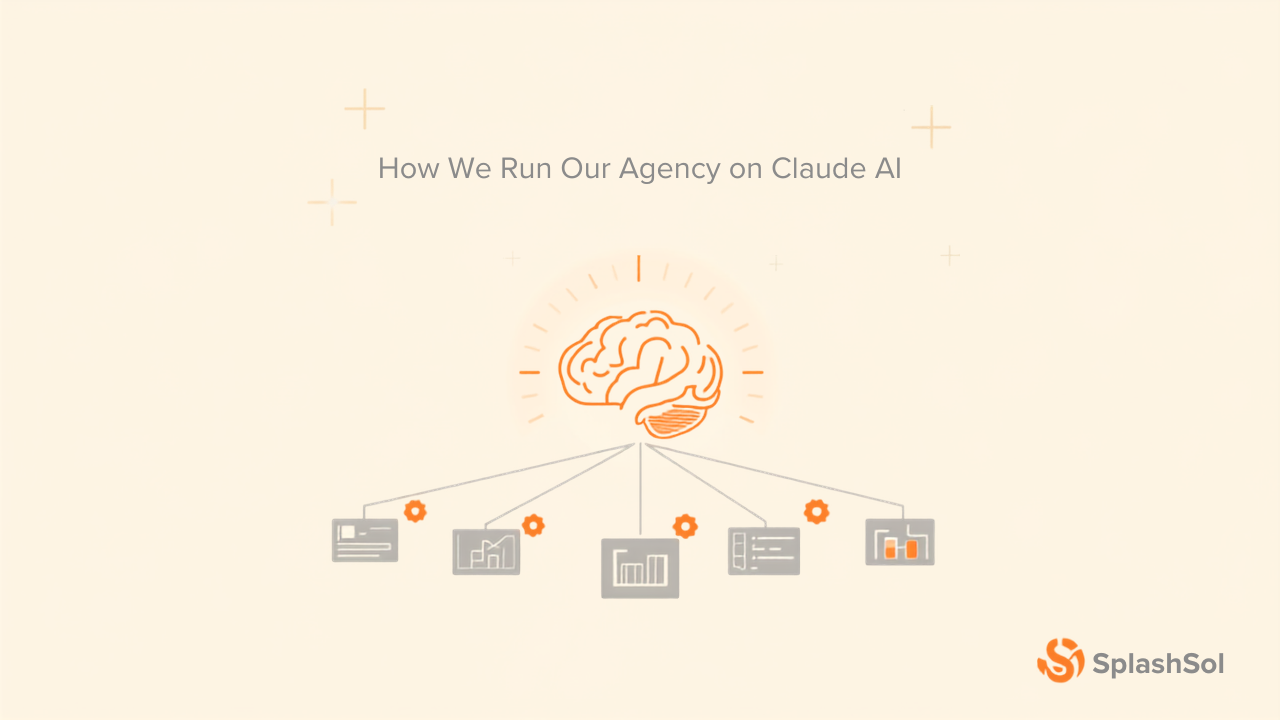
We run our entire SEO and web design agency on Claude AI — from content briefs and technical audits to reporting, QA and internal operations. This is not theory or a sales pitch. Below is the exact stack we use every day at SplashSol, what we automate, what we deliberately keep human, and how you can apply the same system to your own business. If you would rather we build it for you, that is exactly what our AI automation service does.
Why an Agency Runs on AI in 2026
Marketing agencies live or die on two numbers: quality and margin. Manual work protects quality but destroys margin — every report, audit and draft eats billable hours. Cheap, unsupervised automation protects margin but destroys quality, and in SEO that means thin content, missed errors and, eventually, lost rankings. For years agencies had to pick one.
AI changed that trade-off. Used properly, it is the first tool that improves quality and margin at the same time — but only if you are disciplined about where you apply it. The winners in 2026 are not the agencies that “use AI”; they are the ones that know precisely which tasks to hand to the machine and which to keep with an experienced human. That distinction is the whole game, and it is what this article is about.
At SplashSol we made a decision early: rather than bolt AI onto a traditional agency, we would rebuild our operations around it and prove every workflow on our own business before offering it to clients. Everything below is running in production right now.
Our Claude AI Agency Stack
Here is the full stack, function by function. Notice that every single row keeps a human in the loop — automation handles the heavy lifting, people own the judgement.
| Function | Primary tool | What is automated | What stays human |
|---|---|---|---|
| Content briefs | Claude | SERP analysis, outline, entities, questions | Angle, brand voice, final call |
| Drafting | Claude | First drafts, meta tags, schema | Fact-checking, E-E-A-T, polish |
| Technical SEO | Screaming Frog + Claude | Crawl, error detection, prioritisation | Fix decisions, dev handoff |
| Reporting | Looker Studio + Claude | Data pull, narrative summary | Strategic recommendations |
| Rank tracking | Semrush / Ahrefs | Daily tracking, alerts | Response to movement |
| Quality assurance | Claude | Broken links, schema validation, tone | Final sign-off |
| Operations | Zapier + Claude | Lead routing, summaries, follow-ups | Relationships, sales |
The Content Pipeline, Step by Step
Content is where most agencies waste the most time, so it is where we automated hardest. Here is the exact pipeline every article — including this one — passes through:
What used to take a full working day per article now takes roughly two hours of human time — and the human time is spent where it genuinely moves the needle: the angle, the expertise, the fact-checking and the final edit. The machine handles research structure, formatting, meta tags and schema.
The Numbers: What This Actually Saves
We track this carefully, because “AI saves time” is meaningless without measurement. Across a typical month, our automation stack delivers:
The 60 hours is not hypothetical — it is measured against how long the same tasks took our team manually in 2024. The 3x content output comes at the same quality bar, because briefs and first drafts are pre-built. The faster fix time comes from automated crawl monitoring that flags issues the moment they appear, instead of at the next manual audit.
The Golden Rule: Automate the Deterministic, Keep the Judgement
If you take one thing from this article, take this. Every task in a business sits somewhere on a spectrum from fully deterministic to fully judgement-based. Get the placement right and automation is a superpower; get it wrong and you either burn hours or ship damaging work.
| Safe to automate (deterministic) | Keep human (judgement) |
|---|---|
| Rank tracking & alerts | Content strategy & angle |
| Crawl & error monitoring | Link outreach & relationships |
| Report generation | Interpreting the data |
| Meta tags & schema | Final editorial sign-off |
| Data entry & routing | Client trust & communication |
The failure mode we see most often in other agencies is automating the right-hand column — letting AI publish unedited content or make strategy calls. That is how brands end up with generic, inaccurate pages that quietly erode their authority. Automate the left column ruthlessly; protect the right column fiercely.
A Real Workflow: From Keyword to Published Post
Let us make this concrete. Here is the actual process this very article followed, with the human checkpoints marked:
- Brief (automated): Claude analyses the top 10 ranking pages and builds an outline with entities, sub-questions and internal-link suggestions pulled from our sitemap.
- Draft (automated + human): Claude writes a structured first draft. A strategist then rewrites the introduction, injects real first-hand experience, and checks every factual claim.
- Optimise (automated): Meta title, description, FAQ schema and image alt text are generated to spec.
- QA (automated): A script validates links, schema and readability, and flags anything off-brand.
- Publish & monitor (automated): The post is scheduled, indexed, and tracked — with an alert if rankings move.
If you want a starting point for your own content brief automation, here is the exact prompt skeleton we use with Claude:
You are an SEO content strategist. For the keyword "[KEYWORD]":
1. Summarise the search intent in one sentence.
2. List the entities and sub-topics the top 10 results cover.
3. Propose an H2/H3 outline that is more complete than any single competitor.
4. Suggest 5 FAQ questions real users ask.
5. Recommend 3 internal links from this sitemap: [PASTE URLS].
Keep it factual. Flag anything you are unsure about.
What This Means for Your Business
You do not need to be an agency to benefit from this. Any business that produces content, sends reports, tracks performance or routes leads has the same deterministic-versus-judgement split — and the same opportunity. A local SEO client of ours reclaimed two full days a month just by automating reporting and rank monitoring, with zero drop in quality because a human still reads and interprets every report before it goes out.
The barrier is rarely the technology; it is knowing where to start and where to stop. That is precisely the map we build for clients: audit the workflows, automate the deterministic 70%, and design human checkpoints into the rest.
The Tools We Actually Pay For
People often assume running an agency on AI means a huge software bill. It does not. Our entire stack costs less than a single junior salary, and it replaces far more than a single person’s output. Here is what we actually pay for and why:
| Tool | Role in our stack | Why it earns its place |
|---|---|---|
| Claude | Reasoning, content, analysis, internal tools | Long context and strong reasoning make it reliable for real work, not just chat |
| Semrush / Ahrefs | Rank tracking, backlinks, audits | The data backbone every automation reads from |
| Screaming Frog | Technical crawling | Scheduled crawls feed our monitoring automatically |
| Looker Studio | Reporting dashboards | Free, connects everything, and Claude writes the narrative on top |
| Zapier / Make | Connecting the tools | The glue that lets systems talk to each other with no code |
The lesson for any business: you almost certainly already own most of the tools you need. The value is not in buying more software — it is in connecting what you have and adding intelligence on top.
The Three Mistakes We See Most Often
Because we now build automation for other businesses, we see the same avoidable mistakes again and again. Learn from them before you start:
1. Automating the wrong end of the spectrum. The single most damaging error is letting AI make judgement calls — publishing unedited content, deciding strategy, or replying to sensitive customer messages unsupervised. Automate the routine; supervise the rest.
2. Boiling the ocean. Trying to automate everything at once guarantees frustration. The businesses that succeed automate one workflow, prove it, and only then move to the next. Momentum beats ambition here.
3. Removing the human checkpoint too early. Automation earns trust gradually. Keep a review step until the output is consistently right, then relax it. Pull the human out on day one and you will eventually ship something embarrassing.
How We Protect Quality and E-E-A-T
Google’s guidelines reward content that demonstrates real experience, expertise, authoritativeness and trust — the E-E-A-T framework. AI, used carelessly, undermines every one of those signals. So we built our process to strengthen them instead. Every published article carries a named human author who has reviewed and fact-checked it. First-hand experience — like the exact stack and numbers in this very post — is added by a person, because a model cannot invent genuine experience it never had. Claims are checked against primary sources before publishing, and nothing goes live without a human sign-off.
This is why AI-assisted content does not have to mean low-quality content. The machine accelerates research and structure; the human supplies the experience, accuracy and accountability that both readers and search engines reward. Done this way, you get the speed of automation without sacrificing the trust that actually drives rankings and conversions.
Getting Started: Your First Automation This Week
You do not need to rebuild your whole business to feel the benefit — you need one win. If you run a business and want to copy what we do, here is the single highest-leverage place to start, and it takes less than a day to set up.
Begin with automated reporting. It is the task most businesses hate, do inconsistently, and could hand over entirely. Connect Google Analytics and Search Console to a free Looker Studio dashboard, then use Claude to write a short plain-English summary of what changed and why it matters. Schedule it to arrive in your inbox — or your client’s — on the first of every month. That one automation typically reclaims three to five hours and, just as importantly, makes your reporting consistent instead of something that slips when you get busy.
Once that is running and you trust it, move to the next task on your list. The compounding effect is the real prize: each automation frees time that you reinvest into building the next one, until a meaningful chunk of your routine work simply runs itself.
Where Agency Automation Is Heading
The direction of travel is clear. Over the next few years, the routine execution layer of marketing — tracking, reporting, drafting, monitoring, formatting — will be almost entirely automated across the industry. That is not a threat; it is a shift in where human value sits. When execution is cheap and fast, the premium moves to strategy, creativity, judgement and trust — the things a model cannot authentically provide.
The agencies and businesses that thrive will be the ones that embraced this early, built the systems, and freed their people to do the work that actually differentiates them. That is the bet we made with SplashSol, and it is the same bet we help our clients make. The tools will keep improving; the winning principle — automate the deterministic, protect the judgement — will not change.
Frequently Asked Questions
Want This System in Your Business?
- 🤖 AI Automation Services — we build your stack
- 🔍 SEO Services — Glasgow & Scotland
- 💻 Web Design
- ⚡ Free Automation Audit
Explore More from SplashSol
Your Glasgow-based SEO, web design and AI automation partner — serving Glasgow, Edinburgh, Aberdeen and all of Scotland. Explore our services, areas, industries, free tools and guides.