SEO

SEO for Tradesmen in 2027: A Practical Scottish Business Guide

SplashSol • Practical 2027 planning

Updated 24 November 2026 · Examples are labelled · Sources below

Quick answer

Trades SEO starts with accurate local information, clear pages for the work you actually do and a reliable enquiry route. Show real projects, answer quoting questions and measure suitable enquiries. More town pages or generic blog posts are not a substitute for that work.
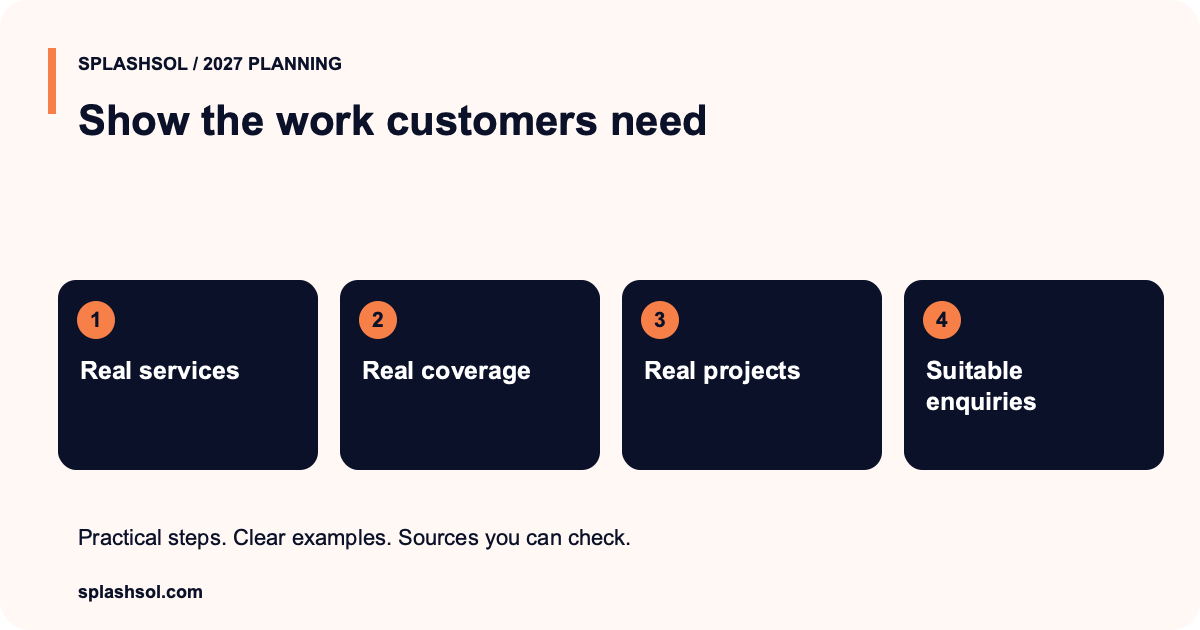
SEO for Tradesmen in 2027: A Practical Scottish Business Guide — Real services, Real coverage, Real projects, Suitable enquiries
Use accurate service information and genuine project evidence to help suitable customers enquire.
On this page

Help the right customer decide to contact you

A homeowner looking for a repair and somebody planning a major extension need different information. Before choosing keywords, list the jobs you want, the areas you can genuinely reach and the questions that decide whether an enquiry is suitable. That gives a trades business a better starting point than publishing the same “best plumber” paragraph for twenty towns.

This guide uses Scottish trade examples for 2027 planning. The examples are demonstrations, not client case studies or promises of rankings. Check any technical, qualification or regulatory claims against your actual work and current professional requirements before publishing them.

Build a small, useful page structure

Use separate pages where the customer need is genuinely different
Page What a customer needs Useful link
Main service Jobs covered, exclusions, service area and how to enquire Relevant project and quote-preparation guide.
Specific service The details that differ from other services Main service and the correct contact route.
Project example Location at an appropriate level, scope, real photos and lessons The service used on that job.
Service-area page Useful local detail you can support Relevant services available in that area.
Contact or quote form The minimum details needed to respond Hours, expected reply time and any urgent contact instructions.

Choose terms from real jobs and enquiries

Write down the phrases customers use when they first contact you. Group them by job: a leak repair, consumer-unit replacement or loft conversion is a different request. Check current search results to understand whether the query calls for a local service, advice or a product. A tool’s search volume is an estimate; it does not tell you how many suitable customers your business will win.

Use a specific title and a clear opening explanation. Include the location where it helps somebody understand your coverage. Do not repeat a keyword in every heading or add places you do not serve. The search preview tool can help check how a proposed title reads, but Google may choose different title text in results.

Three worked Scottish examples

Illustrative content briefs, not advice about carrying out trade work
Trade Page to improve Questions to answer Evidence to add
Plumber serving Paisley and nearby areas Plumbing repairs Which faults do you handle? What details or photos help? When can somebody expect a reply? A genuine repair example, accurate hours and a tested call link.
Electrician serving a defined Glasgow area Consumer-unit replacement What does the first assessment cover? What affects the quote? What is excluded? Real qualifications stated accurately and a project with permission.
Builder working around Stirling Home extensions What information is needed before a site visit? How are scope and timing agreed? A real project sequence, responsibilities and an explanation of the quotation process.

Make the Google profile match the business

Use the business’s real name and appropriate category. Keep phone, service area and hours consistent with the website. Follow Google’s address rules for service-area businesses; do not claim a staffed office where one does not exist. Ask for honest reviews after actual work and reply without revealing private job or customer details.

Work through the local SEO checklist and check Christmas and New Year hours before the holiday period. If you do not offer emergency cover, say so clearly rather than using “24/7” as a marketing phrase.

Use project photos properly

  • Get permission where needed and remove unnecessary personal details, house numbers or paperwork.
  • Show a useful sequence: the requirement, work completed and finished result. Do not imply a stock image is your project.
  • Write a descriptive caption and useful alt text. Avoid placing a town-name list in the image description.
  • Explain what the example demonstrates and where the scope was limited. A result on one job is not a guaranteed outcome for every customer.

Make an enquiry easy to handle

A form asking for name, contact details, area and a short job description may be enough to start. Ask for extra information only when it helps you respond. Test what happens after submission: does the owner receive it, does the customer see a useful confirmation, and is the promised reply time realistic? Use the lead response templates to set expectations when you are on site or closed.

What to do over the next month

  1. Week one: correct profile details, test the form and decide which jobs you want more of.
  2. Week two: improve the highest-priority service page using real enquiry questions.
  3. Week three: publish one permitted project example and link it from the service page.
  4. Week four: review relevant search queries, suitable enquiries and completed work. Decide the next page using that evidence.

If you need a new site, prepare the website brief before comparing quotes. A larger site is only useful when somebody can keep the information accurate.

Separate urgent jobs from planned projects

A customer with an immediate problem needs different information from someone planning work for spring. An urgent-service page should make the actual operating hours, service area and available contact route clear. A planned-project page can explain the stages, the information needed for an estimate and examples of similar work.

Only advertise an emergency or round-the-clock service if the business can deliver it. A website form being available overnight does not mean an engineer will attend overnight. When there is no emergency cover, explain when enquiries are reviewed and avoid button text that suggests an immediate response.

For larger work, help the customer understand how to begin. A builder may need photographs, a location, an outline of the project and a preferred timescale before deciding whether a site visit is appropriate. Clear preparation instructions can reduce the exchange of incomplete messages and help suitable enquiries reach the quotation stage.

Build a keyword list from the work you actually want

Begin with completed jobs and enquiries, not a list of every trade-related phrase. Write the service in the customer’s language, add genuine locations, and include the questions asked before a booking. “Boiler replacement”, “consumer unit replacement” and “garage conversion” represent different buying needs and should not all lead to an undifferentiated list of services.

Check Search Console for the phrases already producing relevant impressions. Separate people searching for the business name from people looking for a service. Review the page Google shows for each useful query and ask whether it answers that need. Existing evidence can reveal a page worth improving before you create something new.

Keyword examples in this guide are planning prompts, not verified monthly search volumes or guarantees of demand. Use current research and your own enquiry history before committing time or advertising spend. A highly specific service with modest search demand can still matter if it matches profitable work the team can actually fulfil.

Give each important service page a complete job

A useful page explains the work, who it suits, where it is available, how the process works and what the customer should send. Include relevant limitations. If the business does repairs but not full installations, or works on particular property types, say so before somebody fills in the form.

Service-page planning prompts for three trades
Trade example Questions to answer Helpful evidence
Plumber Which faults are handled, where, at what times, and how is attendance confirmed? Actual service details, genuine project photographs and a clear assessment route.
Electrician What work is offered and what information is needed before an estimate or visit? Accurate current credentials where relevant, scope and examples of completed work.
Builder or joiner Which projects fit the business and what happens before a quotation? Permission-based project stories, stages, coverage and preparation instructions.

Avoid filling these sections with generic claims that could apply to any contractor. “Send photographs of the existing space and tell us your postcode” gives a customer a practical next step. “We offer comprehensive solutions” usually leaves them needing to phone for basic information.

Turn a completed job into a useful project story

Ask the person who carried out the work to describe the starting problem, the agreed scope and the steps taken. Keep the account factual. A short explanation of why a particular layout or sequence was chosen can help a future customer understand the service far better than a photo labelled “another happy customer”.

Use photographs with permission and remove unnecessary identifying details. Describe the area at an appropriate level, such as a town, without publishing a private address. Check that image captions explain the actual work and do not imply the business completed tasks handled by another contractor.

Link the story to the relevant service page. A kitchen joinery example should help the reader find the kitchen service and its enquiry process. If the project involved unusual requirements, make those limits clear rather than presenting it as the standard package every customer receives. Do not invent a job value, completion time or client quotation to make the story appear more impressive.

Handle Scottish coverage accurately

Choose the towns and areas the business can sensibly serve. Travel time, job type and team capacity may all affect coverage. A contractor could accept a larger planned project farther away while keeping small repairs within a narrower area. Explain the actual arrangement instead of publishing a long list of towns with no practical meaning.

If you create a page for a particular area, include information useful to a customer there: services available, how visits are arranged and genuine examples where permission exists. Avoid copying the same page repeatedly with only the place name changed. A concise coverage page can be sufficient when the service and process are identical across the area.

Keep Google Business Profile consistent with the real business. A service-area business should follow the current address and profile rules; a virtual mailing address is not a substitute for an eligible customer-facing location. Do not create fictional branches to make the map look busier.

Check the enquiry route while somebody is on site

Trades customers often use a phone while looking at the problem or property. Test whether the service details are readable, the phone link works, and the form can be completed without zooming or guessing what a field means. Ask for the minimum information needed for the next decision.

If photographs are accepted, explain the file limits and check the upload from an ordinary phone. Avoid making an upload mandatory when a customer may not be able to provide one. Offer another route if needed. W3C’s form-label guidance is a useful reference for the person building the page.

Then check the office end of the process. Does the message arrive with the customer’s contact details and project information? Who owns it when the usual person is working away from the desk? An enquiry acknowledgement should describe the real next step, not promise a quotation before the work has been assessed.

Build reviews into the normal completion process

After genuine work is complete, ask for honest feedback through the platform’s permitted review route. Keep the request short and optional. Do not offer rewards for positive ratings, write a review for the customer or send the link only to people selected for being enthusiastic.

Agree who responds and how private job details are handled. A professional reply can acknowledge feedback without discussing a customer’s address, payment history or personal circumstances in public. If a review appears to break platform rules, use the reporting process rather than turning the response into an argument.

Keep service information accurate alongside the reviews. A profile with strong feedback still causes confusion if the hours, phone number or linked website are wrong. Use the local SEO checklist for that wider review and the holiday-hours guide before the Christmas break.

Measure suitable work and the quotation stage

Record the service requested, area, enquiry date and whether the request progressed. Keep unsuitable requests visible with a brief reason, such as outside coverage or a service not offered. That information helps improve the page and targeting rather than treating every message as an equal success.

A fictional builder receiving ten enquiries might find that four are suitable, two receive quotations and one becomes a confirmed project. Those are example counts, not a conversion benchmark. The next improvement depends on where requests stopped progressing. A slow estimate process needs a different response from a service page attracting the wrong type of job.

Allow time for planned work to develop. Compare similar periods where possible and note changes in capacity, weather, advertising or the service offer. Put the next few actions into the one-page marketing plan, with one named owner and a review date. Keep the work focused on enquiries the business can answer and fulfil.

Frequently asked questions

Can a small trades business compete without a large blog?

Yes. Start with clear service information, a trustworthy profile, real evidence and a working enquiry route. Publish advice when it answers a distinct customer question.

Should every town have its own page?

Only when the page can provide useful, distinct information for customers there. Repeated pages with swapped place names are a poor foundation.

Can you guarantee first place on Google?

No. Search visibility depends on competition and many factors outside a supplier’s control. Ask for a clear scope, evidence and reporting instead of a guaranteed position.

Sources and checks

Prepared for 2027 planning. Sources checked on 24 November 2026; provider prices and product screens can change.

Sheikh Ahmad
Written by Sheikh Ahmad
SplashSol Digital Marketing Team

Sheikh Ahmad is the founder of SplashSol, a Glasgow-based digital marketing agency specialising in SEO, PPC, web design, and social media advertising. With years of experience helping businesses grow their online presence, Sheikh Ahmad leads a team dedicated to delivering measurable, performance-driven results.

Table of Contents

Free Consultation

Ready to Grow Your Rankings?

Get a free SEO audit and a tailored strategy from our experts.

Get Free SEO Audit
Keep Reading

Related Insights